
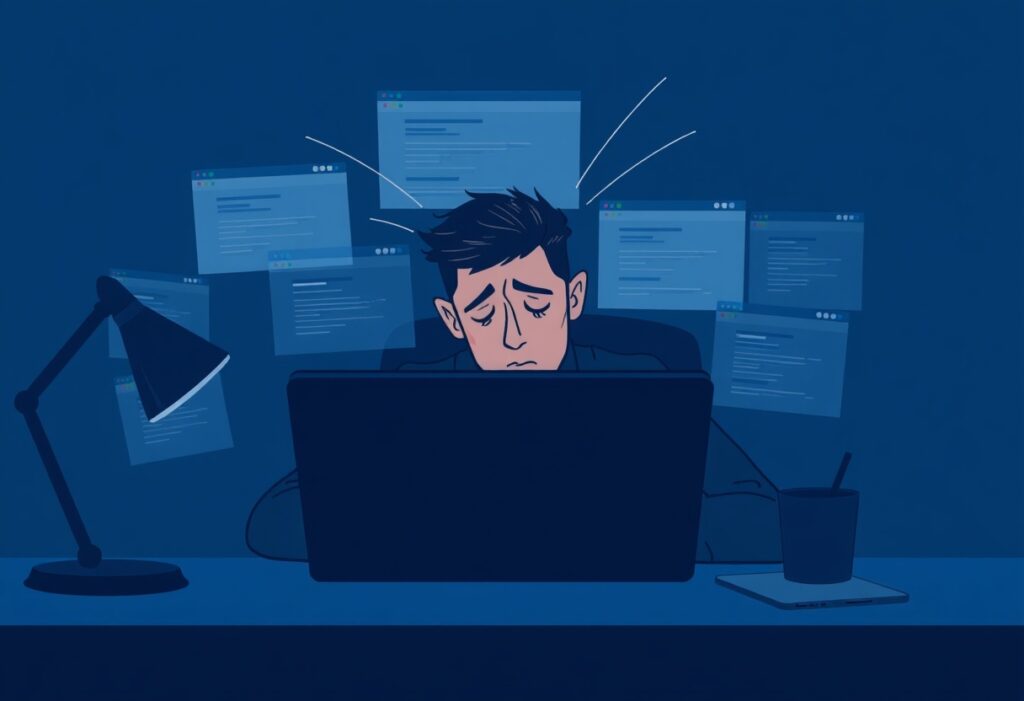
Late Nights and the Hidden Limits of “Parallel Processing”
We all know from experience that staying up late weakens our concentration and memory. Before an exam or a deadline, pulling an all-nighter often leaves your mind sluggish, and information you thought you had mastered becomes harder to recall. These effects are usually dismissed as an obvious consequence of being tired—something that simply “can’t be helped” when we don’t get enough sleep.
However, recent research reveals that the story doesn’t end there. When sleep is insufficient, it’s not just concentration that declines—the brain’s fundamental ability to handle multiple tasks at once deteriorates far more quickly and severely than most people realize. Even if you feel like you’re still functioning or that your efficiency hasn’t dropped, your brain may already be struggling to allocate attention properly, resulting in slower reactions and more frequent oversight.
In this article, we examine how sleep deprivation affects the brain’s attention systems—particularly its capacity for parallel processing—based on an experimental study conducted after 40 consecutive hours without sleep. Rather than simply concluding that “lack of sleep reduces concentration,” we take a closer, scientific look at what is actually happening inside the brain when we stay up too late.
What Exactly Was Tested During 40 Hours Without Sleep?
To investigate how sleep deprivation affects human attention, the researchers designed an experiment under deliberately extreme conditions. The participants were healthy young adult men who were required to stay awake for a full 40 consecutive hours. The study was conducted in a tightly controlled environment—light levels, posture, meal content, and meal timing were all regulated—so that factors other than sleepiness would not interfere with the results.
Throughout the 40-hour period, participants completed attention-measurement tasks every two hours. A key feature of the experiment was that the cognitive load increased step by step rather than focusing on a single simple task. They began with a basic auditory-reaction task, then moved on to tasks requiring simultaneous processing of sounds and visual information. In the final stage, they were additionally required to track a moving object on a screen while performing the previous tasks.
In other words, the study was designed to mimic real-world multitasking and examine how far the brain can keep up under growing demands.
By comparing how reaction speed and accuracy changed when participants performed one, two, and then three tasks simultaneously under sleep-deprived conditions, the researchers aimed to reveal the limits of the brain’s parallel processing capacity.
Attention Starts to Fray Even in Simple Tasks
One striking finding was that the effects of sleep deprivation appeared clearly even in the simplest, single-task conditions. Participants were asked to perform a basic attention test: listening for sounds and responding only to specific target tones. This task required no special knowledge or complex decision-making—under normal, well-rested conditions, most people could complete it with ease.
Yet as the hours without sleep increased, reaction times steadily slowed, and the number of errors rose consistently. Even the most routine form of attention began to fall apart.
Even more important is the type of errors that increased. Many people associate sleep deprivation with “poor judgment” or making the wrong choice, but that wasn’t the main pattern observed in this study.
What rose most sharply were failures to respond at all—even when the correct stimulus was clearly presented. These were not mistakes of choosing the wrong answer; they reflected brief lapses in attention, moments when the brain simply failed to register or act on incoming information.
These findings suggest that sleep deprivation does not merely weaken attention overall—it makes it unstable. You may feel as though you are still working and staying focused, but internally, your attention is flickering on and off, creating more moments in which essential information slips by unnoticed.
Because these brief lapses are difficult to detect subjectively, people often maintain the illusion that they are “still fine” or “still functioning,” even as their actual performance quietly deteriorates.
If you’ve ever felt that your late-night work was filled with unexplainable mistakes—“I don’t know why I’m messing up,” or “I was doing fine a moment ago, and suddenly I blanked”—that may not be a matter of willpower. It could be a sign that your attention has become unstable due to lack of sleep.
And when this unstable foundation is pushed further by trying to juggle multiple tasks at once, what happens next?
The Moment When Parallel Processing Falls Apart
The effects of sleep deprivation became even more pronounced when participants had to perform multiple tasks at once. The study included not only single-task trials but also conditions requiring two and then three tasks simultaneously.
During the two-task phase, reaction delays and errors did increase, but overall performance still remained within a range that could be described as “barely holding on.”
However, the moment participants were asked to manage three tasks at the same time, everything changed dramatically.
When the triple-task load was introduced, reaction times slowed dramatically and the number of errors surged. Importantly, this deterioration wasn’t simply because participants “started to feel sleepy.” Instead, the sleep-deprived state itself appears to have pushed their parallel processing capacity beyond its limits.
Crucially, the participants were not slacking off or losing motivation. They were instructed throughout the study to perform each task “as accurately and as quickly as possible.” Even so, their brains could no longer maintain stable processing of three simultaneous streams of information.
These findings highlight that the mindset of “I can push through if I focus” or “I can power through with willpower” simply doesn’t hold up under sleep deprivation. When the foundation of attention becomes unstable, increasing the workload forces the brain to preserve some processing at the expense of dropping others.
As a result, without the person noticing, reactions become slower and critical signals are more likely to be missed.
The common experience of thinking “I thought I handled everything, but looking back there were so many mistakes” during late-night work closely reflects this very phenomenon. For a sleep-deprived brain, multitasking isn’t a strategy for efficiency—it becomes a trigger that accelerates cognitive breakdown.
Why Does Sleep Deprivation Cripple Our Ability to Process Multiple Tasks?
Why does our capacity for parallel processing drop so sharply when we lack sleep? The key lies in the fact that the brain has only a limited pool of attentional resources. Although we often feel as if we are multitasking, we are actually switching and allocating attention rapidly behind the scenes.
This system works smoothly only when the brain is in a healthy, well-rested state—something that adequate sleep helps maintain.
However, when we become sleep-deprived, not only does the total amount of available attentional resources shrink, but the brain’s ability to direct those resources also weakens. As a result, when multiple streams of information arrive at the same time, the brain struggles to judge what is important or to prioritize effectively.
The increased number of “missed responses” observed in the study reflects this breakdown. It suggests that the brain, in its sleep-deprived state, could no longer reliably determine where attention should be focused.
What makes this even more problematic is that the state of impairment doesn’t match how we feel. Even when sleep-deprived, many people believe they can still “think clearly” or “keep working.” But in reality, attention is flickering on and off, and moments of delayed or incomplete processing are increasing.
In other words, a sleep-deprived brain creates a gap between subjective concentration and objective performance. This mismatch is a major reason why multitasking during late-night hours becomes both risky and inefficient.
Why Staying Up Late Quietly Drains Your Efficiency
As we’ve seen, sleep deprivation doesn’t just increase drowsiness—it fundamentally weakens the brain’s ability to process multiple tasks at once. The sharp performance collapse that occurs when task demands rise makes it clear that beliefs like “I can power through if I try harder” or “I can cover it with focus” simply do not hold up.
Late-night multitasking is not a strategy for improving efficiency. Instead, it pushes your attentional system past its limits far more quickly, accelerating cognitive overload.
When studying or working doesn’t produce the results we expect, many of us assume the problem is “not enough time” or “not enough effort.” But this research suggests that the real issue may lie not in willpower or motivation, but in the state of the brain itself.
When sleep is sacrificed, attention becomes unstable and parallel processing collapses more easily. If your goal is truly to improve efficiency, the most rational choice may not be to increase your workload, but to first secure adequate sleep and create an environment where you can focus on a single task at a time.
References
Chua, E. C.-P., Fang, E., & Gooley, J. J. (2017).
Effects of total sleep deprivation on divided attention performance.
PLOS ONE, 12(11), e0187098.
https://doi.org/10.1371/journal.pone.0187098