
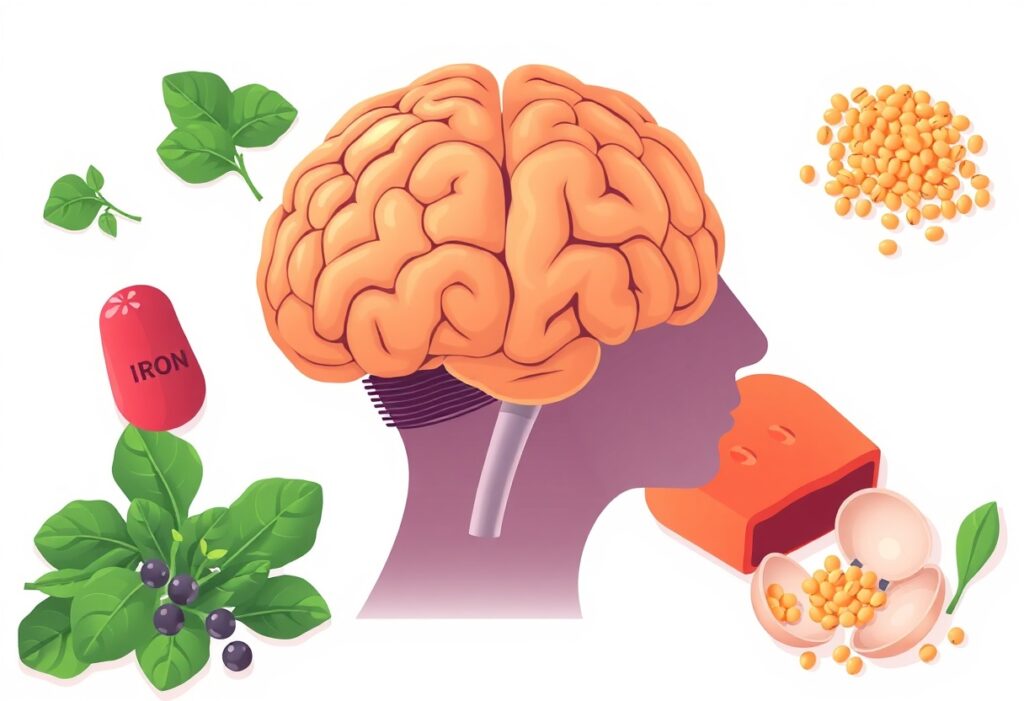
The Real Reason You Can’t Stay Focused—and the “Unexpected Factor” Behind It
Many people have experienced moments when they think, “I just can’t stay focused,” or “I keep getting distracted and can’t get started.” But it may come as a surprise that iron, a nutrient we rarely associate with attention, could play a role in these struggles. When we talk about focus problems, we tend to imagine issues with personality, motivation, or willpower. However, recent research suggests that iron deficiency may influence how the brain functions, potentially affecting our ability to concentrate.
When we hear the word “iron,” we usually think of anemia or feeling easily fatigued. But that’s not the whole story. Iron also serves as a key material for producing dopamine, a neurotransmitter that plays a vital role in attention and behavioral regulation. This means that when iron levels are low, it can lead not only to tiredness but also to a state in which staying focused becomes more difficult.
Over the past few decades, as research on ADHD (Attention-Deficit/Hyperactivity Disorder) has advanced, the connection between iron deficiency and attention has become clearer. Multiple studies have reported that children with ADHD often have lower iron levels, and that this may be related to challenges with sustained attention or hyperactivity. Of course, iron deficiency alone cannot explain everything, but it is certainly one factor that cannot be ignored when trying to understand these symptoms.
In this article, we will start with the basics: what role iron plays in the brain. Then we will walk through what recent ADHD research has revealed. And rather than simply listing scientific findings, we will explain them as clearly as possible while adding insights that readers can apply in everyday life.
If you’ve ever wondered whether your focus problems might be “your fault,” this is information worth knowing. Let’s take a closer look at the deep relationship between iron and the brain.
Why is iron linked to how the brain works?
When we think of iron, we often imagine blood or physical strength, but in reality, it plays an essential role in brain function as well. One reason is dopamine, a neurotransmitter deeply involved in “focusing attention,” “maintaining motivation,” and “regulating behavior.” To produce dopamine, the brain needs iron as one of its key building materials. This means that when iron is lacking, the brain may struggle to produce adequate dopamine, which can make it harder to sustain attention or stay calm.
In addition, iron is crucial for transporting oxygen throughout the body. Although the brain accounts for only about 2% of our body weight, it consumes more than 20% of the body’s total energy—a true “energy powerhouse.” To function properly, it requires a steady supply of oxygen. But when iron levels are low, the efficiency of oxygen delivery decreases, which can lead to sensations like “mental fog,” “slower thinking,” or a general decline in cognitive sharpness.
Considering these roles, it’s not surprising that iron deficiency can make focus or mood more unstable. Just as physical health shifts from the inside out, the brain’s performance is also influenced by daily nutrition. If you’ve been feeling “it’s hard to concentrate lately” or “my brain gets tired quickly,” it may help to look not only at lifestyle habits but also at whether your brain has the nutrients it needs.
ADHD and Iron Deficiency: What 30+ Years of Research Reveals
Building on the idea that iron is essential for brain function, it is a natural progression that researchers began exploring its connection with ADHD (Attention-Deficit/Hyperactivity Disorder). In fact, reviews summarizing studies conducted over the past several decades repeatedly report that many children with ADHD tend to have lower iron levels. One consistent finding across multiple studies is that ferritin—a marker of the body’s stored iron—tends to be lower in children with ADHD. Low ferritin means reduced “reserve iron” in the body, which may, in turn, affect dopamine production.
Research examining treatment interventions has also found cases in which children who took iron supplements for a certain period showed improvements in inattention or hyperactivity. However, the degree of improvement varies widely among individuals, and it is not as simple as saying that “taking iron cures ADHD.” What matters is the possibility that for some children, iron deficiency may be intensifying their symptoms. In other words, iron may not be the “cause” of ADHD, but it may function as one of the factors that influence how strongly symptoms appear.
Another pattern consistently seen in research is that signs of iron deficiency often correlate with behavioral or attention-related difficulties. Characteristics such as being “easily distracted” or “restless” may be more closely tied to nutritional status than previously assumed. Of course, ADHD is shaped by a complex mix of many factors, and it cannot be explained by iron alone. Even so, looking at the condition through the lens of brain function and nutrition offers an important clue for understanding symptoms more deeply.
How About ASD and FASD? Different Conditions, Different Findings
While the connection between iron deficiency and ADHD is relatively clear, research on ASD (Autism Spectrum Disorder) and FASD (Fetal Alcohol Spectrum Disorder) shows somewhat different patterns. In ASD, some studies report iron deficiency, but the results are not as consistent as those found in ADHD. Because nutritional status, daily habits, and sensory characteristics vary widely from person to person, it is difficult to conclude that “ASD = iron deficiency.” Still, some research points to low ferritin levels or inadequate iron intake in certain individuals, possibly influenced by restricted eating preferences or gastrointestinal issues.
In contrast, in FASD, the impact of iron appears to be more clearly reported in some cases. When a fetus is exposed to alcohol during pregnancy, multiple functions related to growth and metabolism can be affected. As a result, iron deficiency and broader nutritional imbalances are more likely to occur. In some cases, delays in growth or behavioral challenges are observed alongside low iron status, and improving nutrition is considered an important part of developmental support.
These findings show that even within the broader category of “neurodevelopmental conditions,” the relationship with iron differs across conditions. Nutritional status, environmental factors, and developmental stages interact in complex ways, making it impossible to simply say, “Symptoms occur because iron is low.” However, what remains consistent across all conditions is that iron is a foundational nutrient that supports both brain function and physical development—an essential perspective for understanding the bigger picture.
Important Note: Iron Supplements Are Not a “Magic Treatment”
As we’ve seen so far, iron is an essential nutrient for healthy brain function, and when levels are low, it may influence attention or emotional stability. However, this does not mean that “taking iron will fix the symptoms” or “this alone will restore concentration.” In fact, this is exactly the point that requires careful understanding.
First, iron supplements are not a treatment—they are simply one method of addressing a deficiency. Some studies report improvements in certain symptoms among children who had low iron levels and took supplements, but the degree of improvement varies greatly, and these effects do not apply to everyone. Moreover, taking supplements when iron levels are already sufficient can place stress on the body. In children especially, excessive iron intake has been linked to gastrointestinal issues and health risks associated with iron buildup, making self-directed supplementation something to avoid.
Additionally, neurodevelopmental conditions such as ADHD cannot be explained by nutrition alone. Sleep, stress, environmental stimulation, learning style, genetic background, and many other factors all interact to shape symptoms. Iron may influence one part of this picture, but it cannot determine the whole story. This is why, if iron deficiency is suspected, the first step should be to get a blood test at a medical facility to accurately understand your condition.
Viewing symptoms through a nutritional lens can sometimes soften how we perceive them. Realizing that “this might not be a personality flaw” or “my physical state might be playing a role” can feel relieving. However, turning that perspective into action requires grounding in safety and scientific evidence. Because iron is such an important nutrient, it must be managed and supplemented in the right way.
The Connection Between Iron and Focus: Important, but Applied with Care
There is no single reason why focus becomes difficult; daily routines, environment, and emotional fluctuations all play a part. Among these many factors, iron—the focus of this article—is an often-overlooked nutrient that plays a crucial role in supporting healthy brain function. Considering that iron is necessary for producing dopamine, which regulates attention and behavior, it’s not surprising that iron deficiency may contribute to difficulties in maintaining concentration.
Research on ADHD has repeatedly reported cases in which iron deficiency is associated with attention-related challenges, reinforcing the idea that nutritional status can influence behavior. At the same time, it is important to remember that iron alone cannot explain every symptom; multiple complex factors overlap to shape how attention and behavior appear. Still, for some people, simply recognizing that “my difficulty focusing may not be a personality issue” can bring a sense of relief.
If you feel that “it’s been hard to focus lately,” or if you’re concerned about a child’s behavior, it may help to look not only at daily routines but also at the balance of everyday meals. Iron is a nutrient that can be obtained through food, and items such as lean red meat, liver, clams, sardines, spinach, komatsuna, hijiki, beans, and eggs are all well-known iron-rich options. Because plant-based iron is more difficult for the body to absorb, pairing it with vitamin C–rich foods—like bell peppers, citrus fruits, or potatoes—can help increase absorption. These small dietary adjustments can gradually contribute to building a body that is better prepared for sustained focus.
The body and mind are deeply interconnected, and gently supporting both is a reliable step toward regaining concentration. Understanding the relationship between iron and focus is not meant to cause worry, but to offer insight into yourself or those close to you. By bringing scientific knowledge into your daily life and making small, steady improvements, you can move toward a healthier, more balanced everyday experience.
References
McWilliams, K. N., Li, W., Bode, L., & Levin, W. S. (2022). The role of iron deficiency in neurodevelopmental disorders: A systematic review. PLOS ONE, 17(9), e0273819.
https://doi.org/10.1371/journal.pone.0273819