Modern Office Life—and the Overlooked Power of Light
Most of us spend our days under artificial lighting without thinking twice about it. In offices and classrooms especially, we often have limited access to outdoor views or natural daylight. Instead, we work for hours under the same uniform, bright white light. But how often do we stop to ask what that “always-the-same” lighting might be doing to our focus—or even our mood?
In recent years, researchers have started paying closer attention to how lighting conditions shape the way we think and feel. Factors such as color temperature, brightness, and subtle changes in light patterns may influence alertness, sustained attention, and mental fatigue. Light isn’t just something that helps us see—it can act like an environmental “switch” that directly affects brain function.
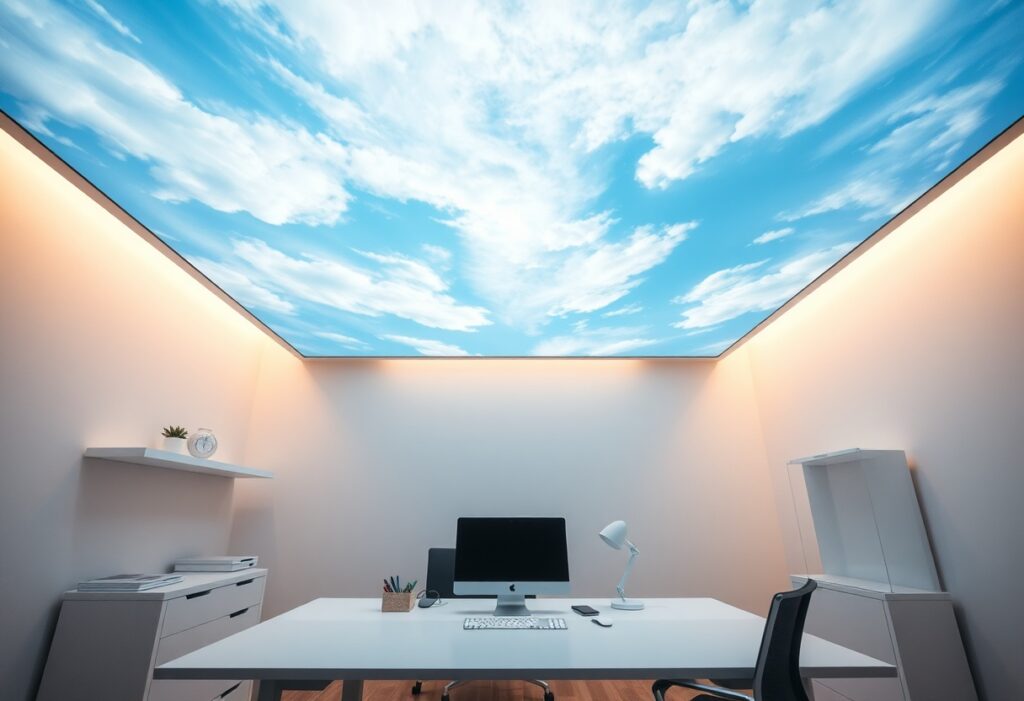
This is where a new type of lighting comes in: Virtual Sky. Designed to recreate the experience of looking up at a blue sky, Virtual Sky uses ceiling panels to produce soft daylight-like brightness and gentle fluctuations—like the subtle shifts you notice when clouds slowly pass overhead. Many people report feeling calmer just by “seeing” a sky indoors, and interest is growing in testing these effects scientifically.
In this article, we’ll break down what Virtual Sky lighting does to concentration, perceived effort, and the psychological load of working—based on data from experimental studies. How close can indoor lighting get to the benefits of natural light in everyday life? Let’s explore the evidence step by step.
What Is Virtual Sky? — A Technology That Creates a “Moving Sky” Indoors
Virtual Sky is a lighting system designed to recreate the feeling of being outdoors under an open sky—even while you remain indoors. Ceiling-mounted panels generate sky-blue colors and a sense of depth, delivering soft daylight-like brightness throughout the room. What makes it unique is that it doesn’t simply glow blue; it can reproduce gentle, cloud-like movements that mimic the natural fluctuations of sunlight.
This dynamic lighting captures the subtle shifts we normally experience outside. Sunlight in nature is never perfectly constant—it changes, however slightly, with passing clouds, atmospheric conditions, and time of day. By bringing this “natural variability” indoors, Virtual Sky aims to provide a level of relaxation and immersion that static lighting simply cannot offer.
Because the color temperature and brightness are not excessively uniform, Virtual Sky is also designed to reduce visual fatigue compared with typical fluorescent or LED fixtures. The way the light spreads from the ceiling resembles natural daylight, offering a sense of being bathed in light—something many users find calming. This can be especially meaningful in spaces where people spend long hours, such as offices and classrooms.
Another important feature of Virtual Sky is that it functions not only as lighting but also as a kind of visual landscape. Viewing an outdoor sky is known to help with mental reset, stress recovery, and emotional balance. Research on “visual natural elements” shows that exposure to nature-like scenes can support sustained attention and reduce psychological strain. Virtual Sky provides a realistic, indoor version of that restorative experience.
What Did the Study Examine? — Comparing Three Lighting Conditions for Eight Hours Each
To understand how Virtual Sky influences people over time, researchers conducted a controlled study with 18 healthy young men. Each participant experienced all three lighting conditions, using a crossover design, which allowed direct comparisons within the same individuals:
- Standard white office lighting
- Static Virtual Sky (sky panels without cloud movement)
- Dynamic Virtual Sky (brightness changes that mimic drifting clouds)
Under each lighting condition, participants spent eight hours performing desk-based tasks in a laboratory space designed to resemble a real office. This long duration was intentional: unlike short laboratory tests, the study aimed to observe how lighting differences accumulate across a full workday.
A wide range of measurements were collected. These included both subjective indicators—such as sleepiness, fatigue, and tension—and objective physiological markers, including:
- EEG recordings to track brain-based sleepiness
- Reaction time and attention measures to assess cognitive performance
- Changes in cortisol, a hormone associated with stress and alertness
Together, these metrics helped reveal how deeply lighting conditions might influence a person’s internal state.
Comfort and visual impressions of the lighting were also evaluated in detail. Participants rated aspects such as glare, warmth or coolness of the light, and perceived brightness. This allowed researchers to compare not only “Does it change performance?” but also “Does it feel comfortable or natural?”
By integrating psychological, physiological, cognitive, and perceptual data, the study aimed to build a comprehensive picture of how Virtual Sky lighting affects the experience of working for long periods indoors.
Cognitive Performance and Sleepiness: Little to No Change Across Lighting Conditions
One of the first questions researchers wanted to answer was whether Virtual Sky could directly enhance concentration. However, the results showed that cognitive performance remained largely unchanged across all lighting conditions. Measures such as reaction time, attention, and task accuracy did not improve under dynamic or static Virtual Sky lighting compared with standard office lighting. Even with moving, natural-like light, participants did not work faster or make fewer mistakes.
The same was true for subjective sleepiness. Participants regularly rated how sleepy they felt throughout the day, yet scores were very similar across all three lighting environments. There was no indication that Virtual Sky made people feel noticeably more alert—or more drowsy—than standard lighting.
Objective markers told a similar story. EEG signals, which reflect brain-based sleepiness levels, showed almost no differences between conditions. In other words, changes in lighting did not produce strong shifts in physiological arousal.
The study also examined cortisol, a hormone tied to stress and alertness. Cortisol typically follows a daily rhythm—higher in the morning, lower toward evening. This natural pattern persisted regardless of lighting type. Virtual Sky did not amplify physiological wakefulness or disrupt normal hormonal rhythms.
Taken together, these findings suggest that Virtual Sky does not significantly boost core cognitive performance or reduce sleepiness in a direct, measurable way. Instead, its impact appears in a different dimension. As we’ll see next, participants experienced clear differences in how much effort and tension they felt during work—a more subtle but meaningful shift in the quality of their work experience.
Why the “Moving Clouds” Still Mattered: Changes in Effort and Tension
The interesting part of the study is that even though cognitive performance itself did not improve, the subjective experience of working showed clear and meaningful differences. Under the dynamic Virtual Sky—where brightness slowly shifted like drifting clouds—participants reported the lowest subjective effort needed to stay focused. In other words, they found it easier to maintain concentration without feeling like they were “forcing” themselves to stay on task.
The results for tension were just as revealing. Participants working under dynamic Virtual Sky lighting felt less tense compared with standard lighting. This wasn’t a drop in alertness or motivation; rather, it reflected a smoother, more sustainable concentration state—working without unnecessary bodily or mental strain. The gentle visual variation in the lighting may help prevent the sense of monotony that can tighten focus in an uncomfortable way.
Importantly, the dynamic condition produced clearer benefits than the static Virtual Sky, where the sky panels remained unchanged. This mirrors real nature: when we look at the sky outdoors, we rarely see a perfectly still blue surface. Instead, we experience a sky with continuous, subtle motion. The study suggests that this naturalistic variability itself may play a role in reducing psychological load. The light’s subtle fluctuations may act as tiny, restorative micro-stimuli that ease stress.
Overall, Virtual Sky does not function as a tool for boosting test scores or speeding up cognitive processing. Instead, it supports the quality of concentration—how comfortable and sustainable it feels to stay focused over long hours. In real work and study settings, where endurance matters more than peak speed, this reduction in perceived effort is not a trivial effect. In that sense, Virtual Sky is best understood not as a performance enhancer, but as lighting that improves the quality of the environment we work in.
Natural-Like Light Makes Work Feel Easier—But It’s Not a Magic Tool
This study makes one thing clear: Virtual Sky is not a device that dramatically boosts raw concentration. Measures such as reaction time, task accuracy, sleepiness, and stress hormones showed no major differences across lighting conditions. On paper, the numbers suggest that Virtual Sky performs much like standard office lighting.
But that doesn’t mean lighting has no effect—its impact simply appears in a more subtle, unexpected place.
What stood out most was the reduction in psychological load. Under dynamic Virtual Sky lighting, participants consistently reported lower effort and lower tension during work. They felt they could focus more naturally, without forcing themselves. Even if performance scores remain the same, producing the same results with less strain carries real value, especially during long hours of study or desk work. Small reductions in effort accumulate—and over time, they can influence productivity, mood, and endurance.
The sense of “naturalness” provided by gentle light fluctuations also played a key role. Unlike static lighting, the slow, cloud-like shifts in brightness helped relax unnecessary mental and physical tightness. This mirrors the environment we experience outdoors, where sunlight continually changes. Being able to recreate even a hint of that “comfort of being in nature” indoors is a meaningful advantage for modern office spaces.
In short, Virtual Sky is not about improving test scores—it’s about improving the environment that supports concentration. By easing psychological strain and making work feel more sustainable, it offers genuine value to anyone seeking a more comfortable, focus-friendly workspace. Virtual Sky reminds us how strongly our surroundings shape the way we feel, even when performance metrics seem unchanged.
References
Schielke, T., Gubo, H., Vizethum, F., & Kazazi, A. (2023).
Visual and non-visual responses to static and dynamic Virtual Sky luminaires
in an office-like environment.
PLOS ONE, 18(7), e0288690.
https://doi.org/10.1371/journal.pone.0288690