
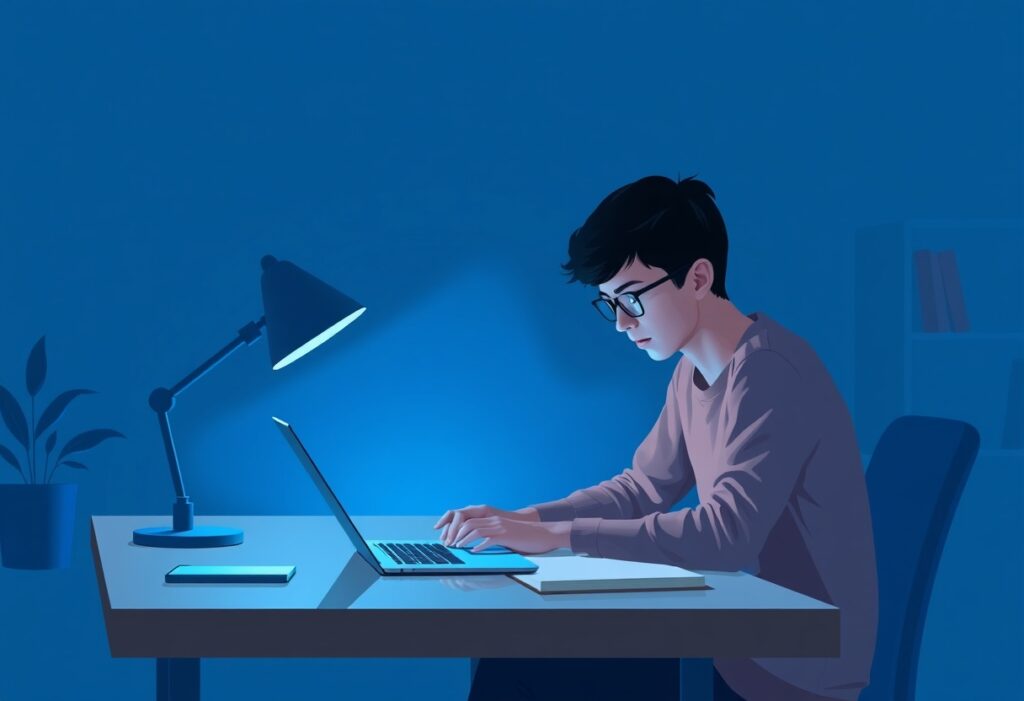
Nighttime Screen Use and Grades: A Common Question
Scrolling on a phone after getting into bed or playing games right up until the moment you try to sleep is no longer unusual. Replying to messages, watching “just one more” video, or playing until you reach a stopping point—before you know it, you have drifted past the bedtime you planned. Scenes like this have quietly become part of everyday life for many students.
The next morning, even if you feel “kind of heavy-headed” or notice that you cannot focus in class, it is easy to brush it off. It might seem like nothing more than a short night of sleep, a self-management issue, or simply a lack of willpower. But is it really that simple? Is nighttime screen use merely a habit that cuts into sleep time—or could it be something more structural, with effects that reach learning and academic performance?
In recent years, sleep science has made it increasingly clear that both the quantity and quality of sleep are closely tied to memory consolidation, sustained attention, and decision-making. Adolescence is especially important: the brain is still developing rapidly, yet daily rhythms are also more likely to become unstable. In that context, it is difficult to judge the impact of screens through intuition alone.
This article explores the question of whether nighttime screen use affects grades by looking at findings from large-scale research examined through the lens of sleep science. The key point is not whether screens are “good” or “bad.” Rather, the goal is to clarify how different patterns of use may influence learning—and through what pathway—so the mechanism becomes easier to understand.
How Are Screens, Sleep, and Academic Performance Connected?
To address this question using evidence rather than intuition, researchers examined real-world data from adolescents. The study focused on 864 students aged 12 to 18, analyzing how screen use, sleep patterns, daytime sleepiness, and academic performance were related. Data were collected across multiple schools, and the analysis was based on responses that closely reflected students’ everyday routines.
A key strength of this research was that screen use was not treated as a single, uniform behavior. Instead, the study distinguished between different activities, such as time spent playing on gaming consoles, using smartphones or tablets, engaging with social media, and watching videos. It also paid attention to when screens were used, including whether devices were used during the hour before bedtime. Alongside these measures, researchers assessed sleep duration on weekdays and weekends, typical bedtimes, levels of daytime sleepiness, and grades in language and mathematics.
What sets this study apart is its focus on structure rather than simple comparison. Instead of asking whether screen use and grades were merely associated, the analysis examined them as part of a sequence: screen use → sleep → daytime sleepiness → academic performance. By tracing this pathway, the researchers aimed to clarify at which stage nighttime screen habits begin to exert their influence, moving beyond correlation to better understand how these factors are connected.
How Did Screen Use Change Sleep Patterns?
The analysis first revealed that the effects of nighttime screen use on sleep were far from uniform. In other words, the relationship was not as simple as “looking at a screen is always bad for sleep.” The magnitude of the impact varied considerably depending on which device was used and what kind of activity was involved.
The clearest pattern emerged with time spent playing on gaming consoles. Students who devoted more time to gaming tended to sleep fewer hours on weekdays. This finding suggests more than just staying up late by chance; it points to the nature of gaming itself as an activity that easily pushes bedtime later. Games often lack clear stopping points, making it easier to postpone the decision to stop—“just a little longer”—and gradually eat into planned sleep time.
By contrast, one particularly interesting result was that using a computer before bedtime did not show a clear association with sleep duration or subsequent outcomes. This highlights the limits of discussing “nighttime screen use” as a single category. Even though all of these activities involve looking at a screen, their effects on sleep were not the same.
To understand these differences, it is important to consider the brain’s level of arousal. Gaming often requires quick reactions, decision-making, and emotional engagement, all of which can keep the brain in a heightened state of alertness. When bedtime arrives in this condition, the body may be ready to rest, but the brain struggles to switch gears. As a result, getting into bed is delayed and total sleep time is reduced.
In this sense, the core issue was not simply whether a screen was used at night, but how strongly the activity stimulated the brain during that time. The findings suggest that the impact of nighttime screen habits on sleep depends not only on how long screens are used, but also on the nature of the activity itself.
What Does Sleep Deprivation Do to the Brain During the Day?
When sleep time was reduced, the next effect to emerge was pronounced daytime sleepiness. In this study, daytime sleepiness was assessed by combining indicators such as difficulty maintaining attention in class, trouble concentrating on tasks, and a general sense of mental fog. The analysis showed a clear pattern: students who slept less were more likely to experience stronger daytime sleepiness.
This sleepiness went far beyond simply “feeling drowsy.” Students with higher levels of daytime sleepiness had more difficulty following information accurately during lessons and were more likely to lose track of explanations midway through. Even when they copied notes from the board, the content often failed to register, and explanations were harder to recall later. In other words, the cognitive processes essential for learning—attention and information processing—were operating at a reduced level.
Sleep is not just a period of physical rest. For the brain, it is a critical time to organize information acquired during the day and consolidate it into memory. When sleep is insufficient, this process is disrupted. The following day is then spent with a brain that is, in effect, not fully prepared to absorb new information. As a result, even when students attend the same classes, differences can emerge in understanding and retention.
What is especially important here is that this state is a physiological response, not a matter of willpower or effort. When daytime sleepiness is strong, the brain simply cannot respond as intended, no matter how much a student tries to concentrate. The issue is not a lack of motivation, but the fact that the brain is operating under conditions that prevent it from performing at its best. For this reason, advice such as “try harder” or “focus more” does little to address the underlying problem.
Taken together, the findings indicate that shorter sleep duration creates conditions that are unfavorable for learning by increasing daytime sleepiness. How the night is spent directly shapes how the brain functions the next day. From this perspective, academic difficulties do not begin in the classroom alone—they may already be set in motion the night before.
The “Real Pathway” Behind Declining Academic Performance
When these findings are viewed together, the relationship between nighttime screen use and lower academic performance looks somewhat different from common assumptions. The study suggests that screen use itself does not directly lower grades in a simple, immediate way. What mattered most were the stages in between—specifically, sleep duration and daytime sleepiness.
The pattern that emerged can be described as a sequence. Certain screen-related activities, particularly spending long hours gaming, tend to push bedtime later and reduce total sleep time. The following day, this shorter sleep is associated with stronger daytime sleepiness, which in turn makes it harder to maintain attention and focus during class. Over time, these effects accumulate, increasing the likelihood of poorer academic performance. Declines in grades, in other words, do not occur suddenly; they develop gradually through several linked steps.
This structure challenges the idea that “using screens at night immediately harms grades.” Instead, screen use appears to function more as a trigger. The factor that truly interferes with learning is arriving at the school day with a brain that has not been adequately prepared by sleep. When sufficient sleep is maintained, the same level of screen use may have a much smaller impact.
This perspective also reshapes how academic difficulties are understood. Problems such as struggling to concentrate, failing to retain information, or falling behind in class are often attributed to a lack of effort or ability. However, these difficulties may already be shaped by the previous night’s routines. In this sense, the source of classroom challenges may lie outside the classroom—more specifically, in how the evening before was spent.
Nighttime screen use becomes problematic only when it reduces sleep and creates conditions that place the brain at a disadvantage for learning. The central message of this research is not whether screens should be eliminated, but how different patterns of use influence learning through specific pathways. This shift in focus leads to a more realistic and constructive way of thinking about screens, sleep, and academic performance.
The Issue Was Not “Willpower,” but the Conditions
The answer this study offers to the question of whether nighttime screen use affects academic performance is not a simple one. The problem was not screens themselves, but how they were used at night—specifically, how certain patterns of use reduced sleep and, in turn, altered the brain’s condition during the day. Declines in academic performance did not arise directly from screen use, but accumulated gradually through sleep loss and increased daytime sleepiness.
Seen from this perspective, difficulties such as “not being able to concentrate” or “struggling to remember things” are not signs of weak willpower or insufficient effort. When adequate sleep is lacking the night before, the brain begins the day at a disadvantage. No matter how hard someone tries, it is difficult to perform at one’s best when the underlying conditions are not in place.
For this reason, the solution is not to eliminate screens entirely. What matters is whether late-night use strongly stimulates the brain or cuts into sleep time. Even small adjustments—such as reconsidering how screens are used in the hours before bed—may improve concentration and learning efficiency the next day. Rather than placing responsibility solely on individuals, a more realistic approach is to focus on shaping the conditions of daily life, especially sleep-related habits, that support learning and performance.
References
Pérez-Chada, D., Arias Bioch, S., Schönfeld, D., Gozal, D., & Perez-Lloret, S. (2023).
Screen use, sleep duration, daytime somnolence, and academic failure in school-aged adolescents.
PLOS ONE, 18(2), e0281379.
https://doi.org/10.1371/journal.pone.0281379