
Questioning the Assumption That “Blue Light Is Bad”
When people hear the term blue light, many immediately think:
“It’s bad for your eyes,” “It ruins your sleep,” “You shouldn’t be exposed to it at night.”
Blue-light–blocking glasses and screen filters have become almost standard whenever we use our phones or laptops for long periods. But is blue light really harmful in every situation?
Recent research suggests a very different story. Light is not just “bright” or “dim.” It also has another important characteristic: color temperature. And this color temperature alone can significantly influence the brain—affecting alertness, attention, and reaction speed.
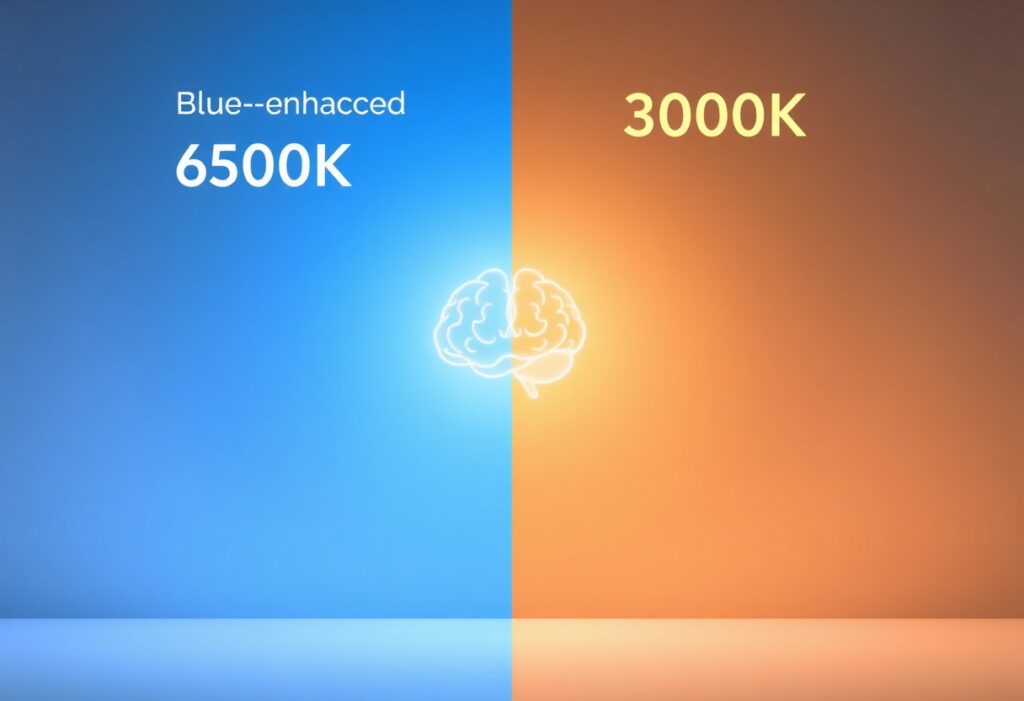
In particular, light that contains a high amount of blue wavelengths—such as cool, bluish light around 6500K—has the power to suppress sleepiness and boost cognitive performance. Yes, exposure at night can interfere with sleep, but during times when you want to stay focused, this same light can serve as a powerful tool to activate the brain.
In this article, we move beyond the overly simplistic idea that “blue light is bad” and explore the science behind how color temperature shapes alertness and cognitive performance—clearly, gently, and based on solid evidence.
Light Stimulates Not Only the Eyes but the Brain
We often think of light merely as something that allows us to “see,” but in reality, it reaches far deeper—directly influencing how the brain functions. When light enters the retina, it is processed through two separate pathways. One carries visual information. The other is driven by a special type of light-sensitive cell called melanopsin-containing intrinsically photosensitive retinal ganglion cells (ipRGCs).
Unlike rods and cones, which are responsible for vision, these melanopsin cells send signals through a non-visual pathway. And the destination of those signals is the suprachiasmatic nucleus (SCN)—the master clock that regulates body temperature, hormone release, sleepiness, alertness cycles, and many other essential biological rhythms.
This means that simply changing the color or wavelength of light can alter how sleepy we feel, how focused we are, and even how stable our mood is.
Short-wavelength light—rich in blue wavelengths—activates melanopsin particularly strongly. This activation suppresses melatonin, reduces sleepiness, and shifts the brain into a more alert, wakeful state.
Neuroscientific studies using fMRI have also shown that exposure to blue-enriched light increases activity in regions such as the brainstem, thalamus, and prefrontal cortex—areas responsible for attention, decision-making, and executive functions. In other words, light does far more than illuminate the room around us; it acts as a biological signal that switches the brain into “on” mode.
Once we understand this background, it becomes much clearer why differences in color temperature can have such profound effects on our performance.
The Alerting Power of 6500K Light (Improved Reaction Time and Focus)
How much can bluish, high–color-temperature light actually influence our ability to concentrate?
To answer this question, researchers conducted a controlled experiment—one with a surprising detail: the light used in the study was only 40 lux, roughly the brightness of typical indoor lighting. In other words, even without using intense illumination, simply changing the color temperature can alter how the brain performs.
In the experiment, participants were exposed to three lighting conditions—6500K (cool, blue-enriched light), 2500K (warm light), and 3000K (slightly warm light)—while performing tasks that measured attention and reaction speed. The results were striking: only under the 6500K condition did reaction times become noticeably faster, and participants maintained steadier, more stable attention.
During tasks that measured decisional accuracy and response speed, those exposed to 6500K light responded faster and more accurately than in the warm-light conditions. This indicates not just a subjective feeling of “being focused,” but a measurable enhancement in sustained attention.
Behind this performance boost was a clear physiological mechanism: stronger melatonin suppression. Under blue-enriched light, melatonin levels dropped more sharply, reducing drowsiness and shifting the brain into a more wakeful, engaged state. This biological shift directly translated into faster reaction times and improved concentration.
Taken together, these findings demonstrate a simple but powerful conclusion: Even at everyday light levels, 6500K blue-enriched light has the ability to elevate cognitive performance.
Why Blue Light Enhances Focus: Melatonin Suppression and Activation of the Brain’s Arousal Network
Why does exposure to blue-enriched light boost concentration and reaction speed so effectively?
The key lies in melatonin, a hormone deeply involved in regulating the body’s internal clock and sleepiness. Melatonin naturally rises at night to make us feel sleepy and falls in the morning to help us wake up. But when we are exposed to blue-rich light, melatonin production is rapidly suppressed, signaling the body that “this is a time for wakefulness.”
As melatonin drops, the brain’s arousal network begins to activate. This includes:
- the prefrontal cortex, which manages decision-making and attentional control
- the thalamus, which relays and filters sensory information
- the brainstem, which maintains overall alertness
It’s as if a coordinated “focus signal” spreads throughout the brain all at once. This response resembles the effect of caffeine. In fact, blue-enriched light acts almost like “caffeine made of light.” It reduces sleepiness, sharpens reaction speed, and stabilizes attention—all at the same time. These combined effects explain why cognitive performance improves so noticeably under 6500K lighting.
In short, blue light does more than simply “wake you up because it’s bright.”
It pushes the brain’s internal wakefulness switch, activating neural systems that sustain alertness and focus.
How to Use Blue-Enriched Light for Nighttime Work, Studying, and Remote Tasks
Once you understand how blue-enriched light boosts concentration, you naturally start wondering:
“So how can I actually use this in daily life?”
In reality, simply being aware of color temperature can dramatically improve both your nighttime productivity and your overall daily rhythm.
For example, during late-night study sessions, report writing, deep work, or any situation where you must stay focused, a cool desk lamp around 6500K can be extremely effective. It activates the brain’s wakefulness switch, reduces drowsiness, and brings back mental sharpness. Tasks that rely on quick reactions or sustained attention—like gaming, coding, or writing—benefit especially strongly from this type of light.
On the other hand, about 1–2 hours before sleep, switching your lighting to a warm tone below 3000K helps your body transition naturally into “rest mode.”
Light with low blue content doesn’t overly suppress melatonin, allowing sleepiness to rise smoothly. This is why looking at bright screens right before bed can disrupt sleep: it’s a direct result of color temperature interfering with your hormone rhythms.
Smartphone features like Night Mode or Blue Light Reduction Mode work for the same reason—they lower the screen’s color temperature to avoid disrupting nighttime melatonin release. However, if you need one last productive push late at night, you can deliberately turn these modes off and use cooler light instead. Adjusting the color temperature to match your goal can noticeably change the quality of your work.
Light control can also be a major advantage for people who struggle with a reversed day–night cycle, those who work night shifts, or those whose routines easily become irregular during remote work. Because light acts as a direct signal to the brain’s internal “timer,” managing it strategically allows you to create your own focus peak or reduce sleepiness whenever needed. It’s a small everyday adjustment, but its effect is far greater than most people realize.
Blue Light Is Neither Good nor Bad — It’s All About How You Use It
When people hear the term blue light, they often think of the negatives first:
“It’s bad for your eyes,” “It disrupts sleep,” “You shouldn’t use it at night.”
But as we’ve seen, light rich in blue wavelengths has the power to suppress sleepiness, activate the brain, and enhance concentration and reaction speed. Simply changing the color temperature—even at the same brightness—can significantly alter how the brain functions. This is the “second dimension of light” that most of us rarely pay attention to.
Of course, exposure late at night can interfere with sleep. But that doesn’t mean “blue light is bad”—it simply means it’s the wrong light at the wrong time.
On the other hand, when you need to stay focused at night, 6500K blue-enriched light can be an incredibly effective ally. And if you switch to warm light before bed, falling asleep becomes much easier.
What matters is treating light not just as illumination, but as a tool for regulating daily performance and supporting your internal rhythm. Simply being aware of color temperature can make a surprising difference in how sharply you work and how smoothly you rest.
Blue light is neither a villain nor a hero.
Used wisely, it becomes a reliable partner—helping you align your focus when you need to work and guiding your body toward rest when you’re ready to slow down. By learning to control light more intentionally, you can shape your own performance more naturally and more freely.
References
Chellappa, S. L., Steiner, R., Blattner, P., Oelhafen, P., Götz, T., & Cajochen, C. (2011).
Non-visual effects of light on melatonin, alertness and cognitive performance: Can blue-enriched light keep us alert?
PLOS ONE, 6(1), e16429. https://doi.org/10.1371/journal.pone.0016429