
Why Do We Feel That Other People’s Stress Is Contagious?
In everyday life, we sometimes experience a strange and hard-to-explain sensation. No one has raised their voice, and no one appears visibly upset, yet the atmosphere feels tense. We may find ourselves feeling uneasy or mentally drained without a clear reason. Many people have likely encountered this sensation at work, at school, or in crowded public spaces, where discomfort seems to arise without an obvious trigger.
Traditionally, such experiences have been explained as psychological effects—an ability to “read the room” or a response to subtle social cues. However, this explanation may not be sufficient. Recent findings in neuroscience suggest that human perception operates on a much deeper, largely unconscious level than previously assumed, allowing us to detect changes in our surroundings without deliberate awareness.
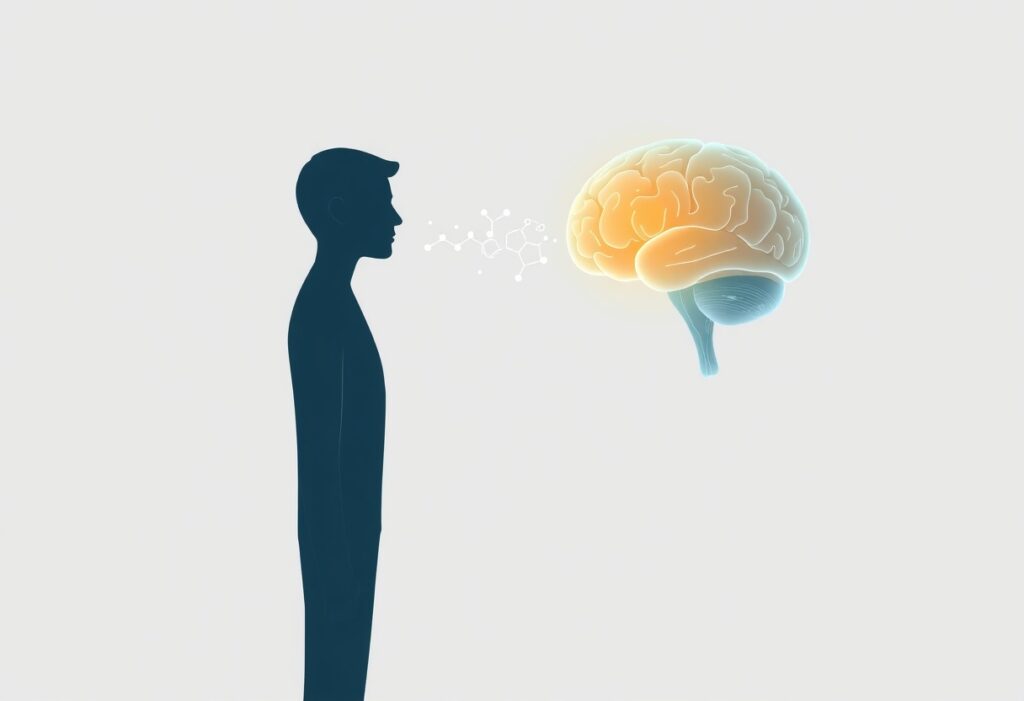
One factor that has recently attracted scientific attention is smell—or more precisely, chemical signals released by the human body. When a person experiences strong emotional stress, physiological changes occur, and information about that state may be emitted through sweat. These chemical signals may reach others nearby and influence their brains without conscious detection. Notably, studies suggest that such signals can activate the amygdala, a brain region deeply involved in emotion processing and threat assessment.
In this article, we explore the question of whether humans truly sense others’ stress through smell. Drawing on evidence from brain imaging research, we examine how unconscious chemical cues may shape emotional perception and vigilance, and what this means for the subtle experiences we often describe simply as “a tense atmosphere.”
Do Humans Also Communicate Emotions Through Chemical Signals?
In the animal world, it has long been known that information about danger or fear can be transmitted through chemical substances. When an individual encounters a predator, it may release airborne signals that spread through the environment and rapidly alter the behavior and physiological state of nearby conspecifics. These signals, often referred to as alarm pheromones, have been documented across a wide range of mammalian species and are understood as an adaptive mechanism for survival.
But how does this apply to humans?
Because humans rely heavily on language, facial expressions, and vocal tone for communication, the idea that emotions might also be conveyed through smell has received relatively little attention. For a long time, odor-based emotional communication was considered either irrelevant or too primitive to play a meaningful role in human social interaction. However, this view has begun to change. Recent research suggests that components of human sweat may carry information that reflects not only physiological states, but also emotional changes such as fear or stress.
Indeed, earlier studies have reported that exposure to sweat collected from individuals experiencing fear or intense anxiety can influence others’ attention, mood, or emotional judgments. These findings hinted that emotional information might be transmitted through chemosensory cues. Nevertheless, most of this evidence was based on observable behavioral changes, leaving an important question unresolved: what is happening inside the brain when such signals are perceived?
This gap leads to a crucial set of questions. Do humans truly detect others’ stress through chemical signals, and if so, where and how is this information processed in the brain? The brain imaging study discussed in this article directly addressed these questions, aiming to determine whether emotional stress can be received as a chemosensory signal and trigger unconscious neural responses in a manner similar to what has been observed in other mammals.
How Did the Study Compare “Stress Sweat” and “Exercise Sweat”?
A key strength of this study lies in how carefully it defined and separated the concept of “stress,” which can otherwise be vague and difficult to measure. The researchers began by dividing sweat donors into two distinct conditions. In one condition, participants performed a first-time tandem skydive. Skydiving reliably induces intense fear and emotional tension, while physical exertion remains relatively limited. For this reason, it was chosen as a situation that primarily elicits emotional stress rather than physical strain.
The second condition involved running on a treadmill for a fixed period of time. This activity produces clear physical stress, such as increased heart rate and perspiration, but does not typically evoke strong fear or anxiety. By using these two contrasting conditions, the researchers were able to compare emotional stress and physical stress while keeping sweat production constant. Sweat samples from both conditions were collected following strict protocols, and careful handling and storage procedures were used to minimize bacterial contamination and other potential confounding factors.
Participants who later inhaled these sweat samples were not informed which condition the samples came from. The stimuli were adjusted so that differences in odor intensity or pleasantness were difficult to consciously detect. While receiving these stimuli, participants underwent functional magnetic resonance imaging (fMRI), allowing researchers to measure brain activity in real time. This approach made it possible to capture unconscious neural responses rather than reactions driven by explicit odor recognition.
Taken together, the experimental design was highly controlled at every stage—from the choice of stressors and sweat collection to participant awareness and brain measurement. As a result, any differences observed in brain activity could be attributed with greater confidence to the emotional content of the sweat, rather than to chance, subjective impressions, or simple differences in smell.
The Amygdala Responded to Stress, Not to Smell
Analysis of the brain imaging data revealed a striking and consistent pattern. Significant activation of the amygdala was observed only when participants inhaled sweat collected under conditions of emotional stress. In contrast, sweat obtained during physical exercise did not produce the same neural response. This finding indicates that the brain was not reacting simply to the presence of sweat, but rather to the emotional information carried within it.
A crucial point is that participants were not consciously aware of any meaningful differences between the two types of sweat. Ratings of odor intensity and pleasantness showed no significant differences between conditions, and participants were unable to reliably distinguish stress-related sweat from exercise-related sweat in discrimination tasks. These results rule out the possibility that amygdala activation was driven by an unpleasant or stronger smell.
The amygdala is known not only for its involvement in fear and anxiety, but also for its role in rapidly detecting potential threats and preparing the brain for heightened vigilance. The fact that this region responded without the participants’ conscious awareness suggests that the human brain may be capable of detecting others’ stress at a very early, automatic stage of processing.
Taken together, these findings provide a concrete neuroscientific answer to the question of whether humans sense others’ stress through smell. Emotional states may be communicated not only through words or facial expressions, but also through subtle chemical signals that operate below the level of conscious perception.
Others’ Stress Changes How We Make Judgments
What makes this study particularly compelling is that the neural effects were accompanied by measurable changes in behavior. The researchers asked participants to perform a task in which they viewed facial expressions that were deliberately ambiguous—faces gradually morphed between neutral and angry expressions. Participants were required to decide whether each face appeared more neutral or more threatening, a situation that relies heavily on intuitive judgment.
The results showed that when participants inhaled sweat collected during emotional stress, their judgments became more precise. Importantly, this did not mean that faces were simply perceived as more frightening overall. Rather than becoming overly sensitive to threat, participants demonstrated improved accuracy in distinguishing between threatening and non-threatening expressions. In other words, their perceptual system appeared to enter a heightened state of vigilance, allowing for more careful and reliable evaluation of subtle cues.
This behavioral pattern is consistent with the observed activation of the amygdala. The amygdala does not function merely as a generator of fear, but as a system for assessing potential risk and coordinating appropriate responses. By receiving chemical signals associated with others’ stress, the brain may interpret the environment as one that warrants closer attention, temporarily sharpening cognitive processing.
Taken together, these findings indicate that others’ stress affects more than shared emotional states. It can alter how we perceive and interpret information at a fundamental level. The vague sense of tension we often experience around stressed individuals may therefore reflect a rational and adaptive response by the brain, rather than a purely subjective feeling.
Stress Is Something We Are Actively Sensing
The most important insight from this study is that the stress we perceive in others may not be mere imagination or subjective impression. Chemical signals released through sweat under conditions of emotional stress appear to reach the brains of others without conscious awareness, quietly activating vigilance-related systems centered on the amygdala. As a result, individuals become more attentive to their surroundings and more accurate in interpreting social cues, such as facial expressions.
This response should not be understood as a sign of vulnerability or emotional contagion in a negative sense. Rather, it reflects an evolutionarily adaptive mechanism that helps individuals detect potential danger or change at an early stage. Humans may rely not only on words, facial expressions, or eye contact, but also on subtle chemical information that operates outside conscious perception to assess their environment.
Feelings such as a “heavy atmosphere” or unexplained mental fatigue in workplaces, schools, or social groups may therefore not stem solely from personal sensitivity or mood. Instead, they may reflect stress that is unconsciously shared within an environment. By reframing stress as something that can be transmitted and sensed, rather than solely carried by individuals, this research offers a new perspective on how we understand social environments. Recognizing the biological basis of these subtle sensations may be an important first step toward creating healthier and more supportive spaces.
References
Mujica-Parodi, L. R., Strey, H. H., Frederick, B., Savoy, R., Cox, D., Botanov, Y., Tolkunov, D., Rubin, D., & Weber, J. (2009).
Chemosensory Cues to Conspecific Emotional Stress Activate Amygdala in Humans.
PLOS ONE, 4(7), e6415.
https://doi.org/10.1371/journal.pone.0006415